Paul Delvaux Antheit, 1897° - 1994†
After a classical education, Delvaux studied at the Royal Academy of Fine Arts in Brussels. From early expressionist influences, he gradually developed a fully personal visual language, instantly recognisable for its dream-eyed female nudes, skeletons, vintage trains, nocturnal stations, and architecture with classical overtones. Together, these elements form a suspended, theatrical universe where the familiar blends with the uncanny.
From the 1930s onward, Delvaux became involved in avant-garde circles and participated in major international exhibitions, including the "Exposition Internationale du Surréalisme" (Paris, 1938). Retrospectives in Mons, Brussels, and Paris further cemented his international reputation. In 1982, the opening of the Paul Delvaux Museum in Sint-Idesbald confirmed the lasting significance of his oeuvre and remains a key institution for understanding his work.
Paul Delvaux Antheit, 1897° - 1994†
Paul Delvaux is one of the most distinctive Belgian artists of the twentieth century. Although often associated with Surrealism, he rejected that label, believing it narrowed the deeper intentions of his work. His aim was to evoke a form of poetic realism-a world shaped by silence, dreamlike atmosphere, and enigmatic tension.After a classical education, Delvaux studied at the Royal Academy of Fine Arts in Brussels. From early expressionist influences, he gradually developed a fully personal visual language, instantly recognisable for its dream-eyed female nudes, skeletons, vintage trains, nocturnal stations, and architecture with classical overtones. Together, these elements form a suspended, theatrical universe where the familiar blends with the uncanny.
From the 1930s onward, Delvaux became involved in avant-garde circles and participated in major international exhibitions, including the "Exposition Internationale du Surréalisme" (Paris, 1938). Retrospectives in Mons, Brussels, and Paris further cemented his international reputation. In 1982, the opening of the Paul Delvaux Museum in Sint-Idesbald confirmed the lasting significance of his oeuvre and remains a key institution for understanding his work.
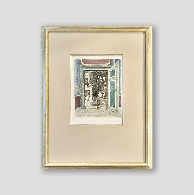
Les derniers beaux jours
1.750 € | 37cm x 30cm
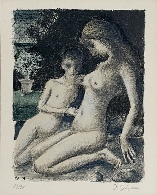
Blue azalea
4.000 € | 46cm x 36cm
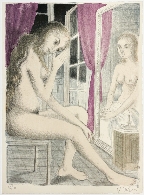
Rideaux mauves
4.000 € | 38cm x 28cm
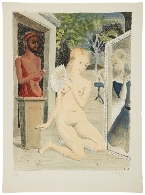
L'Eventail
8.000 € | 76cm x 56cm
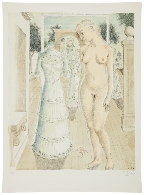
Robe de dimanche
8.000 € | 77cm x 56cm